The Weekend and the Proof
Read time: 3 minutes
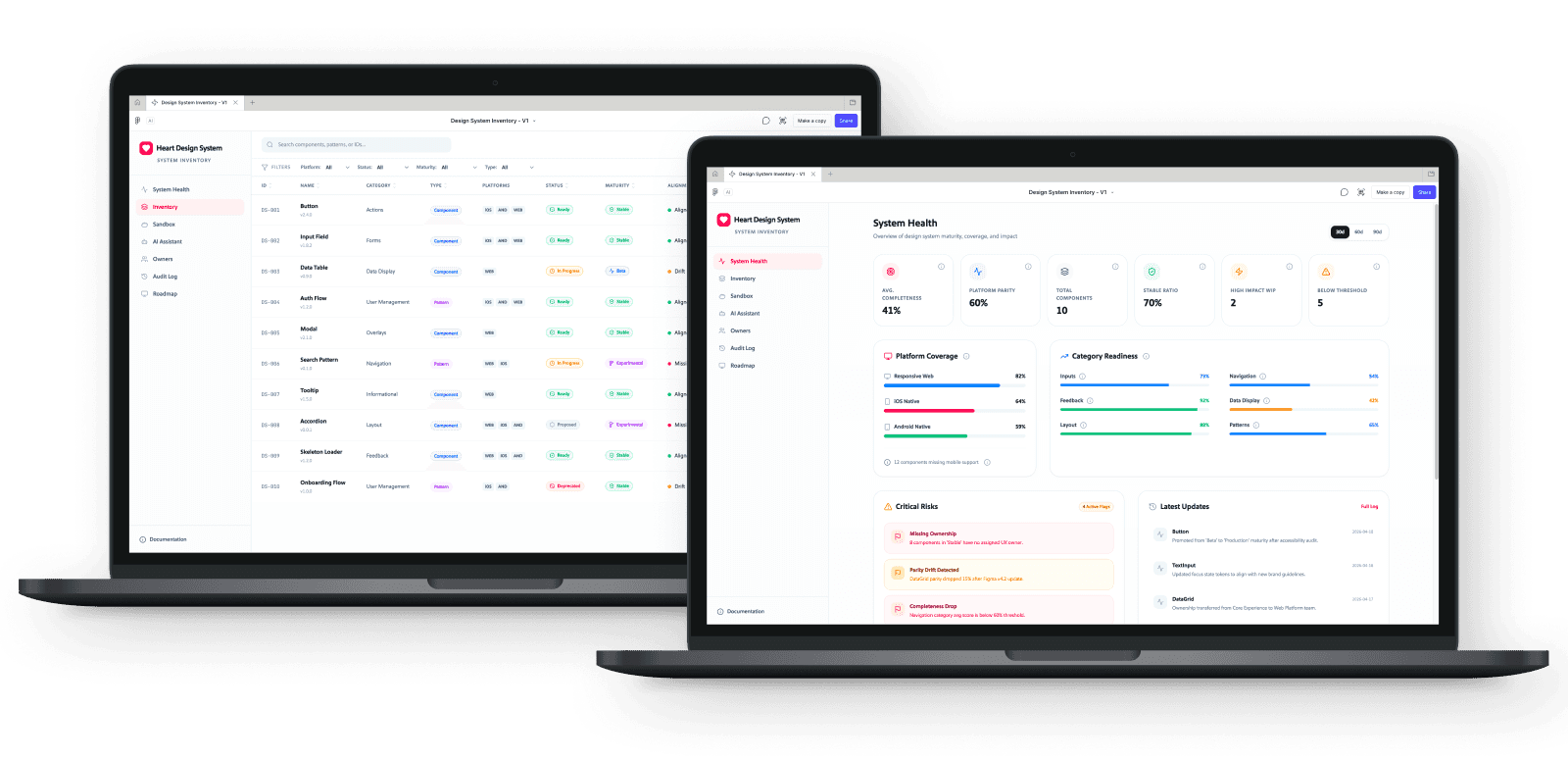
Then came what I'd call my AI awakening. Southwest is conservative about AI tooling, but once internal AI tooling started to land, I prototyped a component inventory tool in a single weekend — partly because I hate sitting still on a problem, and partly because I wanted to know what was possible without the vendor I'd just walked away from.
It included a dashboard for design system health metrics, an agent that could answer real-time questions about the system (freeing my one designer from fielding every question that came up in a project meeting), an intake process that forced actual thought into a component request instead of just lobbing a question at us, visibility into who owns which component, and a booking system to replace poorly-attended office hours.
Most of that is still a vision, not a shipped tool. The prototype is genuinely paused — not actively being built out — because the system itself isn't in a state to be easily made AI-readable yet. It's homegrown and inconsistent in ways that need to be resolved first. But it gave me a concrete case for a larger team, and a real plan for closing out v1 and addressing the gaps that show up when you scale something fast with minimal support.
One outcome is already real. We never moved forward on an estimated $150K-a-year vendor purchase — an early figure from initial conversations, before procurement negotiations would have shaped a final number. We're now planning to build our own tool instead.
The first-ever satisfaction survey for the system, in 2025, returned an NPS of 21.43. The most recent survey, in June 2026, returned an NPS of 52 — a real, measured improvement, tied more to the broader gains we'd made and to people finally getting properly trained on the system than to anything AI-related. What the surveys also surfaced, underneath the headline number, was how apparent the lack of a real docsite and Living Style Guide had become — that's the data that gave us the case to pursue the Component Inventory tool, and everything now planned for v2.
The same surveys also confirmed a governance bottleneck: too much still routes through too few people, myself included. That's not a hidden problem I'm waiting to be caught on — it's one I've said out loud, and it's part of why I'm designing the next version of the system to govern itself where it can, rather than needing a person in the loop for every decision.
I didn't go to art school to become a police officer.
Someone said that at Config earlier this year, and it's stuck with me since — I've been using it as my own shorthand for the governance philosophy I want v2 to run on. If someone needs to go off the system's beaten path, that should be fine, as long as their work still holds up — the burden should be on the designer or builder to justify the exception, not on the design systems team policing every rule.